fashionbriefs
8:41in productionCh. 1 · Factory, not folklore/ 8:41 · ceiling 15 min
Footwear

Converse (brand)

Converse didn’t make culture—it made shoes, and culture wore them anyway.

Converse is a manufacturing company that made functional footwear for specific markets—basketball players, the Rens, the US military. Its cultural weight came later, from reuse, not design intent.

Chapters & takeaways5
  1. 0:55
    Factory, not folklore

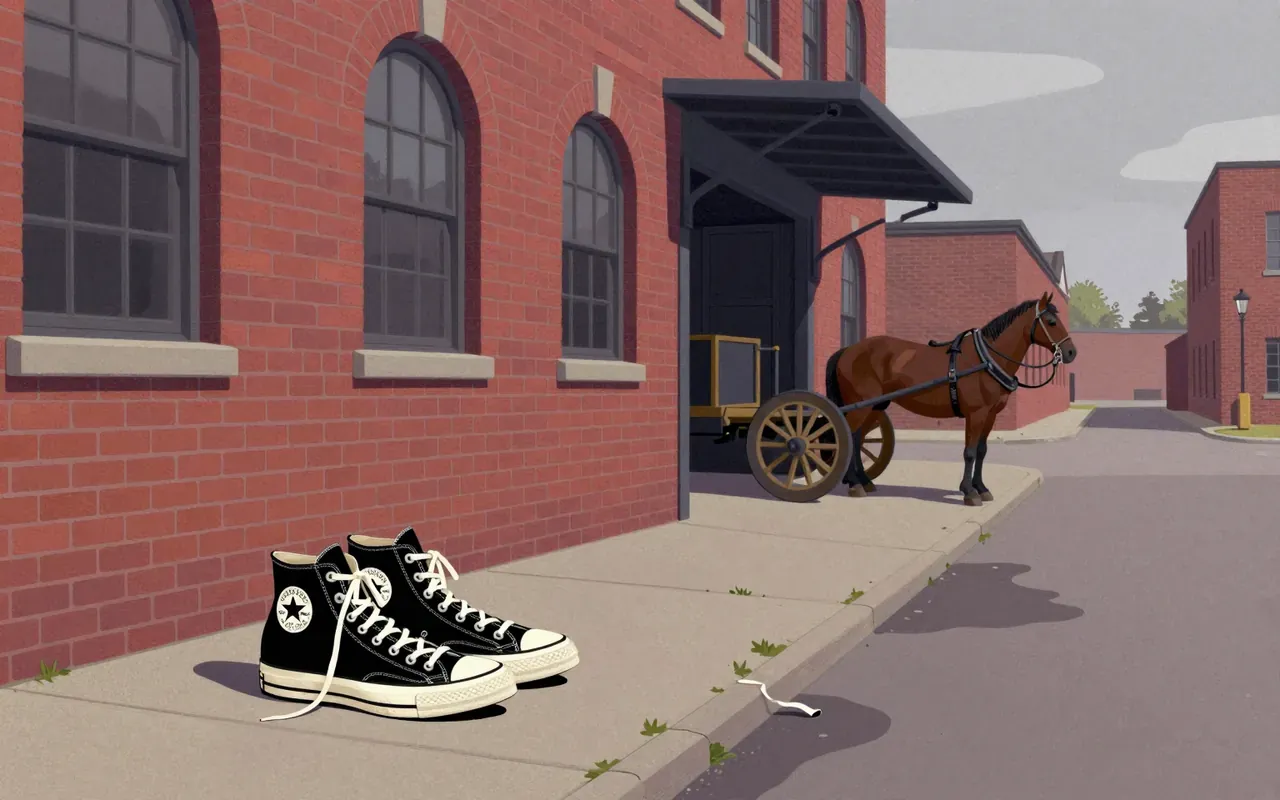
    Converse began as a local rubber shoe factory—not a brand, not a movement.

  2. 2:11
    Built for the court

    The All-Star launched in 1917 to meet a real need: basketball players slipping on wooden courts.

  3. 3:24
    Endorsement as employment

    Chuck Taylor was hired in 1922 as a salesman—not a designer—and his name appeared on the shoe a decade later.

  4. 4:37
    Customised but uncredited

    Converse customised shoes for the New York Renaissance—the first all-Black professional basketball team—yet never centred their story.

  5. 5:41
    War reset the product line

    During WWII, Converse stopped making basketball shoes entirely and built military footwear instead.

Worth your time?

Yes. Wear the whole thing.

3.5/ 5
What works
  • as a case study in unintended cultural absorption
  • as evidence of early 20th-century industrial adaptation
  • as a counterpoint to ‘founder-as-genius’ narratives
What does not
  • influence hip-hop
  • define youth rebellion
  • pioneer streetwear
Wear it if
  • historians of American industry
  • students of material culture
  • designers studying functional-to-symbolic transitions
Skip it if
  • those seeking origin myths
  • fans of retro branding narratives
  • readers expecting cultural commentary without infrastructure
The written brief1 min read

What the thing is

A rubber shoe manufacturer founded in 1908. Not a lifestyle brand. Not a subcultural signifier—at first. A factory making winterised boots, then basketball shoes, then army boots.

Where it came from

Malden, Massachusetts. February 1908. Marquis Mills Converse opened the Converse Rubber Shoe Company after managing another footwear firm. It was regional, industrial, and pragmatic—not aspirational.

What it gets right

It solved a functional problem: basketball players needed grippy, supportive, flexible footwear. The All-Star delivered that in 1917. It adapted fast—hiring Chuck Taylor in 1922, customising for the Rens in the 1920s–30s, shifting to military production in WWII.

What it gets wrong

It did not invent basketball footwear. It commercialised and standardised it. Its early branding erased the contributions of Black athletes beyond token customisation. It treated endorsement as labour, not partnership.

Why it matters now

It shows how infrastructure masquerades as identity: a mass-produced shoe becomes synonymous with rebellion, art, youth—but only after decades of displacement, repurposing, and erasure of its origins.

Is it worth your time

Yes—if you care how a utilitarian product became a cultural vessel without intending to.

Same rail · Footwear4 of 23
9:37
Tod's1920Tod's is a footwear-first Italian house whose foundational garment — the 1979 Gommino loafer — is a documented reinterpretation of The Original Car Shoe. Its identity was built on industrialisation, American branding, and expansion through sister labels. Its reputation rests uneasily between craft lineage and contested claims of origin and production.
8:50
Adidas GazelleThe Gazelle is a functional pivot point: Adidas’s first suede shoe, built for training, split by environment, then repurposed for handball. Its strength is specificity—not versatility, not legacy.
8:15
Adidas SambaThe Adidas Samba is a functional football trainer repurposed. Its strength lies in restraint: minimal construction, targeted grip, unembellished materials. Its limits are physical and categorical—it does not adapt beyond its original brief. It belongs in wardrobes that prize intention over novelty.
9:29
Adidas Stan SmithThe Adidas Stan Smith is a tennis shoe launched in 1965. It evolved from Adidas’s first leather tennis shoe, released in 1963. Originally named Adidas Robert Haillet, it was renamed in 1978 after American tennis player Stan Smith. It features a white leather upper, no external three stripes, three rows of perforations on each side, minimal Adidas branding, and sometimes a sketched portrait of Stan Smith on the tongue. Its design has remained largely unchanged since introduction, though many versions and colorways exist. Materials are white leather, rubber (pimpled outer sole), and synthetic (inner sole). It was originally manufactured in Landersheim, France. Stan Smith was active from the late 1960s to early 1980s.
Up next in Fashion

Denim

· 8:30

Denim isn’t rebellious—it’s bureaucratic. It was issued by railways and air forces long before it was adopted by teenagers.

8:30