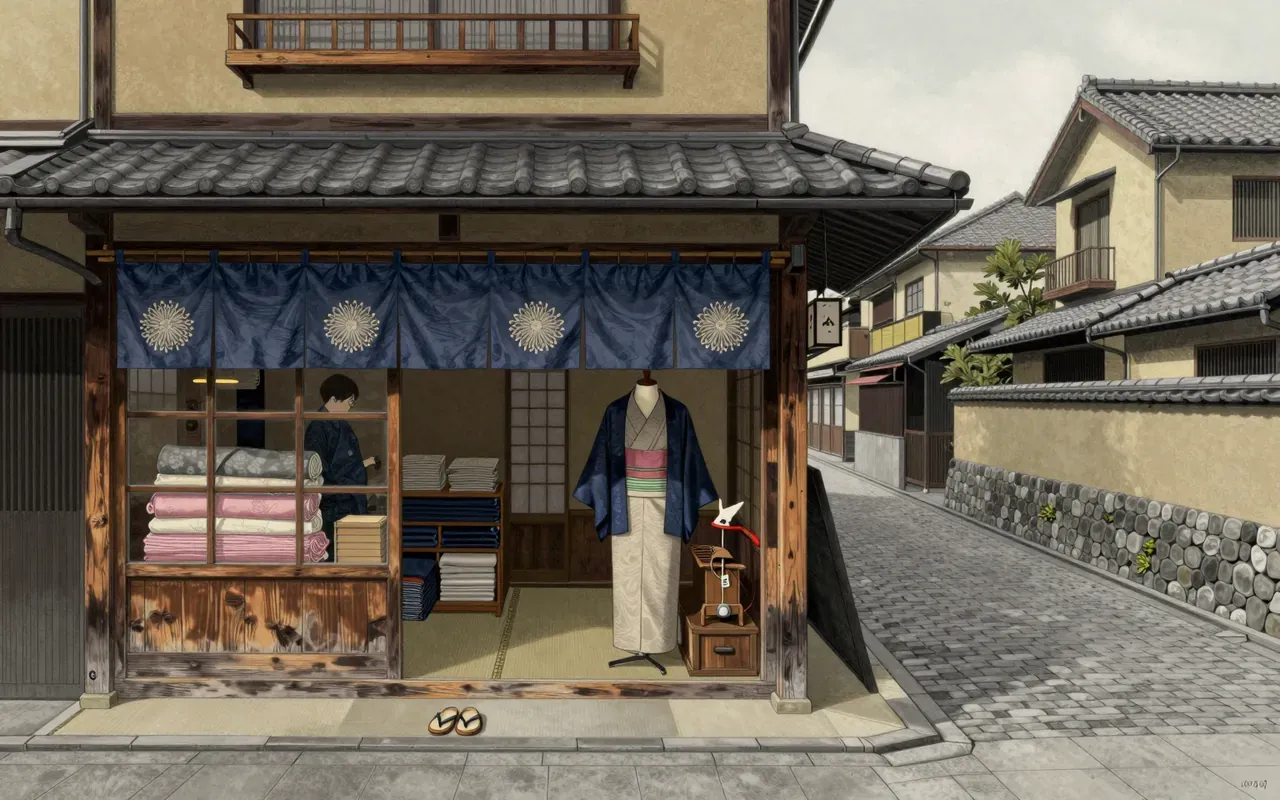
She didn’t bridge East and West — she wore both passports and demanded entry on their terms.
Hanae Mori’s fashion house operated from 1951 to its closure (date unspecified), grew to $500 million by the 1990s, and achieved rare institutional recognition: official haute couture accreditation in Paris, runway presence in New York and Paris, and commissions for national representation including JAL, the Olympics, and the Japanese Crown. Her work was functional, ceremonial, and geopolitically legible — not merely aesthetic.
Her authority began in Japanese cinema — not Paris salons — and extended to New York before she ever set foot in the Chambre syndicale.
2:23
Official Haute Couture Status
She entered the Fédération française de la couture not as an exception, but as an accredited member — the first Asian woman to do so.
4:17
Uniforms as Public Statements
Her JAL uniforms weren’t just clothing — they were mobile national branding, with the 1970 miniskirt version sparking public debate about modernity and propriety.
6:04
State-Commissioned Dress
She dressed Japan’s official face to the world: Olympics delegations and the Crown Princess — ceremonial roles where fashion carried diplomatic weight.
Worth your time?
Yes. Wear the whole thing.
4/ 5
What works
as a case study in institutional access
as evidence of fashion’s role in national representation
as a counterpoint to Eurocentric couture histories
What does not
groundbreaking
iconic
seminal
timeless
Wear it if
designers
historians of global fashion
students of post-war Japanese soft power
Skip it if
casual fashion fans seeking trend inspiration
those expecting subversion or countercultural critique
The written brief1 min read
What the thing is
Hanae Mori is a fashion house founded in Tokyo in 1951, accredited as an official haute couture design house in Paris, and scaled to a $500 million international business by the 1990s.
Where it came from
It came from post-war Japan: Mori opened her first atelier, Hiyoshiya, in 1951 and built early credibility designing costumes for hundreds of Japanese films.
What it gets right
Mori secured official haute couture status in Paris — a gatekept title — and designed uniforms for national representation: JAL flight attendants, Olympic delegations, and the Japanese Crown Princess. Each was functional, ceremonial, and politically legible.
What it gets wrong
The narrative of ‘East Meets West’ collapses real cultural asymmetry into aesthetic shorthand. Her 1965 New York collection bore that title, but the document gives no evidence she interrogated or unsettled those categories — only that she occupied them.
Why it matters now
Because her path — from Tokyo atelier to Paris couture chamber, via New York runways and state-commissioned uniforms — maps a route few non-European designers were allowed to take, and fewer still documented with this institutional precision.
Is it worth your time
Yes — if you want to understand how a single designer redefined Asian presence in Western fashion institutions through sustained, strategic access, not symbolic inclusion.