Kenzo didn’t bring Japan to Paris—he brought Paris to itself, via Montmartre, a flea market, and green paint.
Kenzō Takada’s Kenzō label began in 1970 as a resource-constrained experiment in Paris—using flea-market space, Saint Pierre market fabrics, and Rousseau-inspired interiors. It re-energised ready-to-wear with colour and volume, launching the 'Big Look' in 1973–74. Its methods were specific, local, and materially grounded—not symbolic or national. It reached New York and Tokyo by 1971, but never claimed to represent Japan. Its legacy is procedural: how to build influence without infrastructure.
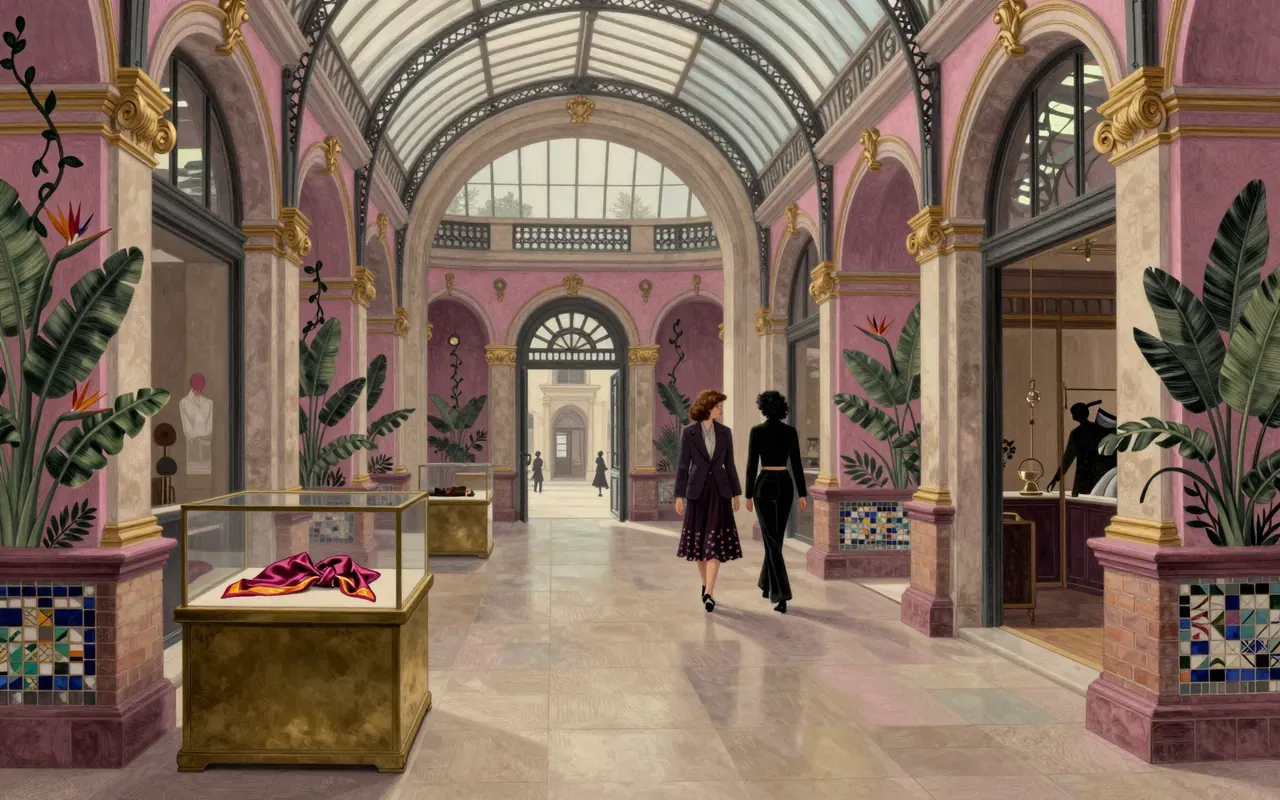
A flea market deal secured the Galerie Vivienne space—and the first show happened there.
2:09
$200 and green paint
The first collection used $200 of mixed fabrics—and acne was painted green for the runway.
3:18
Rousseau in the arcade
The shop’s interior was a hand-painted jungle, inspired by Henri Rousseau’s The Dream.
4:12
Global before the trend
By 1971, his collections were shown in New York City and Tokyo—before the 'Big Look' defined mid-70s fashion.
5:38
The Big Look arrives
In 1973–74, he loosened peasant silhouettes into the voluminous 'Big Look'—the dominant high fashion trend of the mid-1970s.
Worth your time?
Yes. Wear the whole thing.
4.5/ 5
What works
as a case study in constraint-driven innovation
as evidence of how non-institutional spaces shape fashion trends
as a counterpoint to narratives of fashion as capital-intensive spectacle
What does not
represents Japanese tradition
originated streetwear
was avant-garde in the Dada or Surrealist sense
influenced specific later designers
Wear it if
designers working with tight budgets
students studying cross-cultural adaptation in fashion
historians of 1970s Paris retail geography
Skip it if
those seeking origin stories of Japanese luxury branding
readers looking for biographical drama or celebrity narrative
The written brief1 min read
What the thing is
Kenzō is the fashion label founded by Kenzō Takada, a Japanese designer who launched it in Paris in 1970 with a self-funded, DIY-first approach to ready-to-wear.
Where it came from
It came from Montmartre’s Saint Pierre market, a flea market encounter in the Galerie Vivienne, and Henri Rousseau’s jungle paintings—not from haute couture ateliers or Japanese textile dynasties.
What it gets right
It treated scarcity as a design principle. $200 of mixed fabrics, a flea-market space, green-painted pimples—each became part of the aesthetic logic, not a compromise.
What it gets wrong
It never resolved the tension between its handmade, anti-industrial origins and its rapid scaling into international ready-to-wear. The ‘Big Look’ was voluminous—but also commercially scalable in ways the first collection was not.
Why it matters now
It matters now because its model—low-cost space, cross-cultural collage, unpolished casting, interior-as-installation—prefigures how independent designers operate in post-retail, digitally native contexts.
Is it worth your time
Yes—if you care how constraint breeds invention, and how a single boutique in a Paris arcade reshaped silhouette, colour, and presentation in global fashion.