fashionbriefs
9:06in productionCh. 1 · What it is/ 9:06 · ceiling 15 min
Ready-to-wear

Ready-to-wear

Ready-to-wear didn’t liberate dress—it standardised bodies.

Ready-to-wear is industrial clothing infrastructure. It emerged from wartime logistics in New York City. It trades precision for scale. It reshaped who could wear what—and who had to make it.

Chapters & takeaways6
  1. 0:45
    What it is

    It is defined by finish, size standardisation, and mass production—not by price or prestige.

  2. 1:56
    Where it began

    War drove its first industrial scale: US military uniforms in 1812.

  3. 2:48
    How it works

    It works because standard patterns and factory methods keep cost low and fit broadly acceptable.

  4. 4:10
    What it opposes

    It exists only in contrast: haute couture is its mirror, not its ancestor.

  5. 4:56
    What it includes

    Not all ready-to-wear is mass produced: some lines are limited, non-unique, but still not bespoke.

  6. 6:04
    What it extends to

    Off-the-peg applies beyond clothing—it names a logic, not just a garment.

Worth your time?

Yes. Wear the whole thing.

4/ 5
What works
  • affordability
  • reproducibility
  • speed
  • scale
What does not
  • haute-couture
  • tailoring
  • bespoke
Wear it if
  • consumers
  • garment workers
  • retailers
Skip it if
  • people outside standard size ranges
  • those requiring functional adaptation
The written brief1 min read

What the thing is

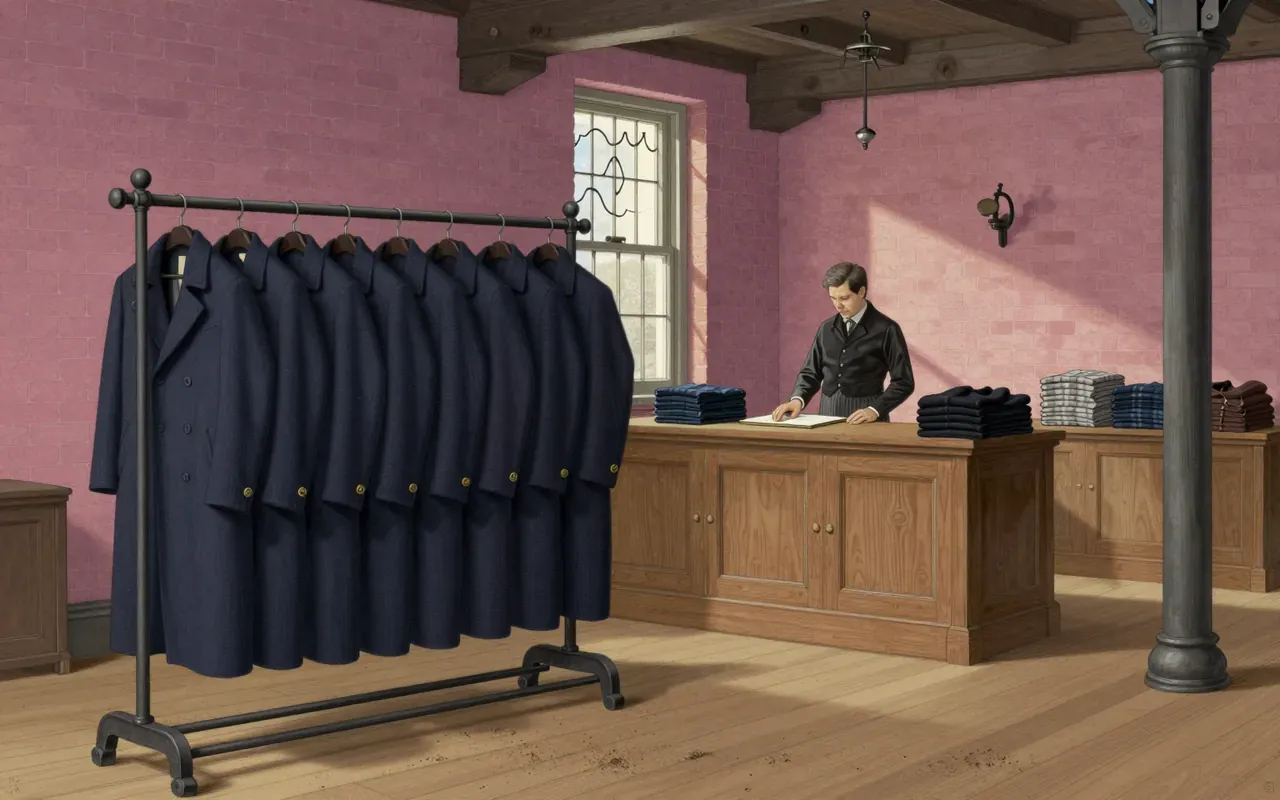
Ready-to-wear is mass-produced clothing in standardized sizes. It is sold finished, off-the-rack or off-the-peg. It is the opposite of haute couture and bespoke.

Where it came from

It began in early 19th-century New York City. The War of 1812 triggered mass production of military uniforms. Men adopted it before women.

What it gets right

It delivers affordable, consistent fit at scale. Standard patterns and factory equipment make garments reproducible. It fits most people without alteration.

What it gets wrong

It assumes a normative body. It cannot accommodate variation in proportion, posture or mobility. It displaces bespoke skill without replacing its precision.

Why it matters now

It underpins fast fashion, supply chains, and global garment labour. Its logic—standardisation over specificity—now governs everything from handbags to healthcare.

Is it worth your time

Yes—if you care how clothing shapes class, labour, and access. It is not a style choice. It is infrastructure.
Same rail · Ready-to-wear4 of 30
8:21
AMI Paris2010AMI Paris is a French ready-to-wear fashion house founded in 2011 by Alexandre Mattiussi. Its name means 'friend' in French and references his initials. It originated from Mattiussi’s desire to create accessible luxury clothing after his experience designing high-end pieces he could not personally afford. The brand expanded rapidly — opening its first Paris boutique in December 2012, launching womenswear in 2019, and growing to over 60 stores and 700 points of sale globally by 2021. Its growth was marked by strategic collaborations (Moncler, GAP, PUMA, Antoine Dupont, Balthazar), digital engagement (over one million Instagram followers by 2025), and recognition including the 2013 ANDAM Fashion Award and 2016 membership in the Fédération de la Haute Couture et de la Mode. Revenue rose from €35 million in 2019 to €300 million for the year ending March 2023.
9:08
Carolina HerreraCarolina Herrera’s garments are built for presence, not participation. They assume the wearer already knows their place — and intend to hold it.
8:38
Fashion weekFashion week is a logistical engine dressed as cultural event. It delivers seasonal collections to trade, not taste. Its structure is rigid. Its sustainability is rhetorical. Its speed is reactive. Its authority is self-appointed.
11:25
Jerry LorenzoJerry Lorenzo founded Fear of God in 2011 without formal fashion training, identifying personal wardrobe gaps as his design impetus. He built the brand on minimalism and comfort within luxury, citing Rick Owens’ transformation of basketball sneakers and Kurt Cobain’s grunge uniform as key influences. His seventh collection referenced the Negro Leagues and his father’s MLB managerial roles. The brand name comes directly from his Christian faith. In 2016, he designed five custom stage outfits and contributed to merchandise for Justin Bieber’s Purpose World Tour, applying Cobain’s aesthetic — graphic tees, flannel overshirts, denim — to mass-produced pieces.
Up next in Fashion

Rick Owens

Rick Owens · 8:15

Rick Owens doesn’t dress people—he calibrates them.

8:15