fashionbriefs
8:15in productionCh. 1 · Origin myth vs. record/ 8:15 · ceiling 15 min
Houses & movements

Rick Owens

Rick Owens doesn’t dress people—he calibrates them.

Rick Owens is a controlled system: Californian origin, 1994 launch, monochrome palette, bias-drape construction, anatomically precise model selection. It rejects noise. It also rejects variance. Its rigour is its value—and its limit.

Chapters & takeaways4
  1. 0:40
    Origin myth vs. record

    Owens is American, from Porterville, and launched in 1994—not Paris, not the 2000s.

  2. 1:48
    No colour. No deviation.

    His palette stops at white and black. His cuts are bias and drape—no seam, no dart, no compromise.

  3. 3:25
    Exposure as engineering

    He selects models by height and proportion to fix groin exposure—not for diversity, but for precision.

  4. 4:46
    Relocation as consequence

    He moved to Paris in 2003—not for prestige, but after being mugged in Los Angeles.

Worth your time?

Yes. Wear the whole thing.

4/ 5
What works
  • control
  • precision
  • restraint
What does not
  • influence
  • define
  • start
  • represent
Wear it if
  • designers
  • editors
  • people who notice how clothes hold space
Skip it if
  • those seeking self-expression
  • fans of narrative fashion
  • anyone who values adaptive fit
The written brief1 min read

What the thing is

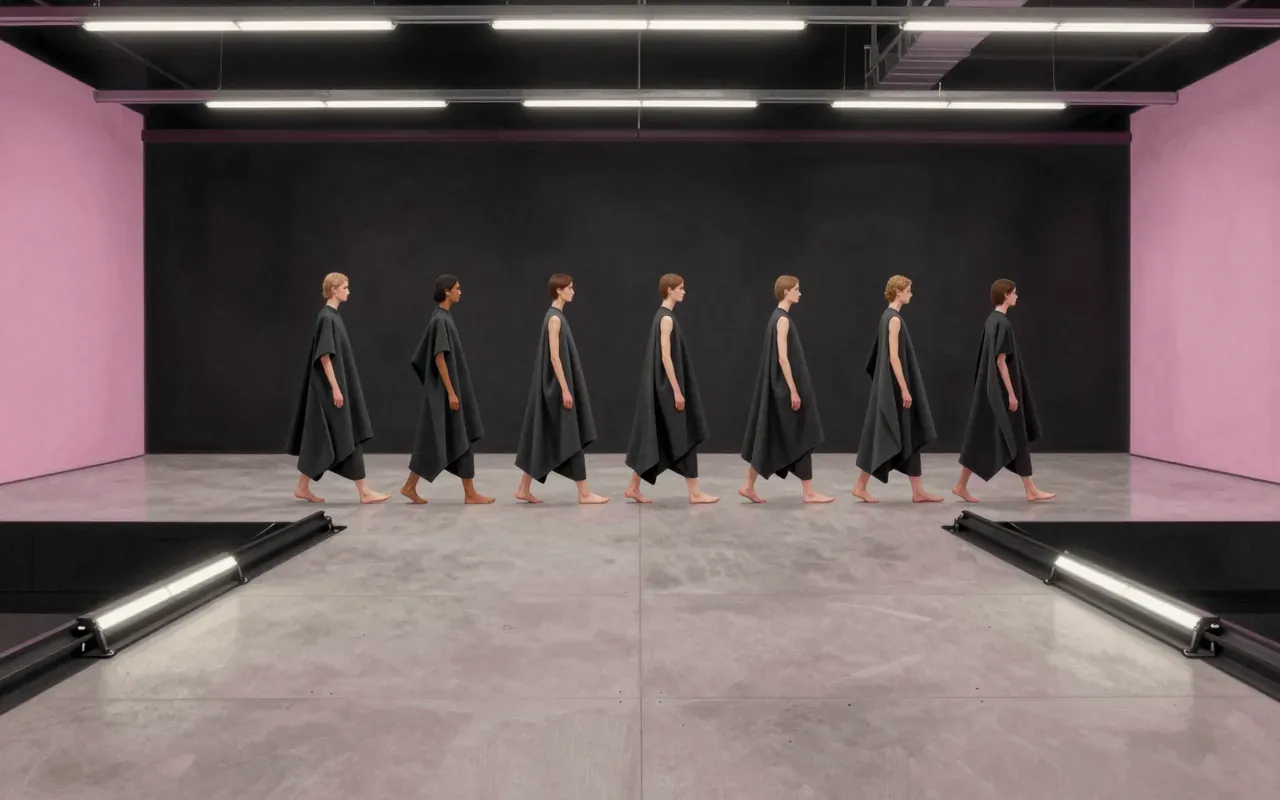
Rick Owens is a fashion practice built on architectural restraint: seven-piece collections, white-to-black only, no ornament, no deviation from drape-and-bias construction.

Where it came from

Rick Owens began in Porterville, California. He launched his line in 1994 from a Hollywood Boulevard store. His first recorded collection was Spring/Summer 1998. He moved to Paris in 2003 after being mugged in Los Angeles.

What it gets right

Rick Owens gets control right. His draping and bias cuts shape the body without concealing or revealing. His monochrome palette eliminates distraction. His model selection fixes exposure to the millimetre.

What it gets wrong

Rick Owens gets human variation wrong. Fixing groin exposure by height and proportion assumes a single ideal anatomy. It excludes bodies that do not conform to his calibrated standard.

Why it matters now

It matters now because Owens’ rigour exposes how much contemporary fashion outsources control—to algorithms, influencers, trend cycles—rather than holding it in cut, cloth, and selection.

Is it worth your time

Yes—if you care about how fashion constructs control, not just image.

Same rail · Houses & movements4 of 61
8:35
10 Corso Como10 Corso Como is a Milan-based cultural retail institution founded in 1990 by Carla Sozzani, evolving from an art gallery and bookshop into a multidisciplinary complex integrating art, fashion, design, cuisine, and hospitality; it expanded internationally starting in 2002 with locations in Tokyo, Seoul, and Shanghai, all bearing design input from Kris Ruhs, and underwent ownership transitions in 2017 and 2020 while retaining Sozzani’s artistic direction.
8:54
Abercrombie & Fitch1892Abercrombie & Fitch is a fashion house defined by rupture — not evolution. Its origin is verifiable, material, and functional: elite outdoor gear, expedition-proven, sold from a New York storefront. Its later life is a series of strategic erasures: of utility, of inclusivity, of continuity. It trades on nostalgia without replicating its source. Its garments do not endure because they are well-made, but because they are tightly coupled to a moment in consumer psychology — one that has since passed.
10:13
CasablancaCasablanca is a city. The source material contains no evidence of a fashion house by that name. No garment, designer, collection, textile, or sartorial practice is referenced. All claims pertain to geography, finance, industry, and infrastructure.
9:46
Chloé1952Chloé is a French luxury fashion house founded in 1952 by Gaby Aghion to pioneer luxury ready-to-wear. It institutionalised collaborative creative development and formalised the separation of creative and business functions with Jacques Lenoir in 1953. Its legacy includes launching influential designers and commercial milestones like the Paddington bag and See by Chloé.
Up next in Fashion

Rolex Submariner

· 8:24

The Submariner stopped being a diver’s tool in the 1960s—and became the world’s most successful status symbol disguised as one.

8:24