8:49in productionCh. 1 · Built for branches/ 8:49 · ceiling 15 min
Accessories
Bowler hat
1850
A hat built to survive branches became a symbol of class—then a tool of colonial displacement.
The bowler hat is a functional object that escaped its origin. Designed in London in 1849 for gamekeepers, it succeeded because it was durable, close-fitting, and unambiguous. It spread across classes in Britain, Ireland, and the US—not because it signalled status, but because it worked. Its later adoption in Bolivia was not organic but infrastructural: brought by British railway workers, then repurposed by Quechua and Aymara women. It does not represent ‘timeless style’. It represents transfer, endurance, and unintended consequence.
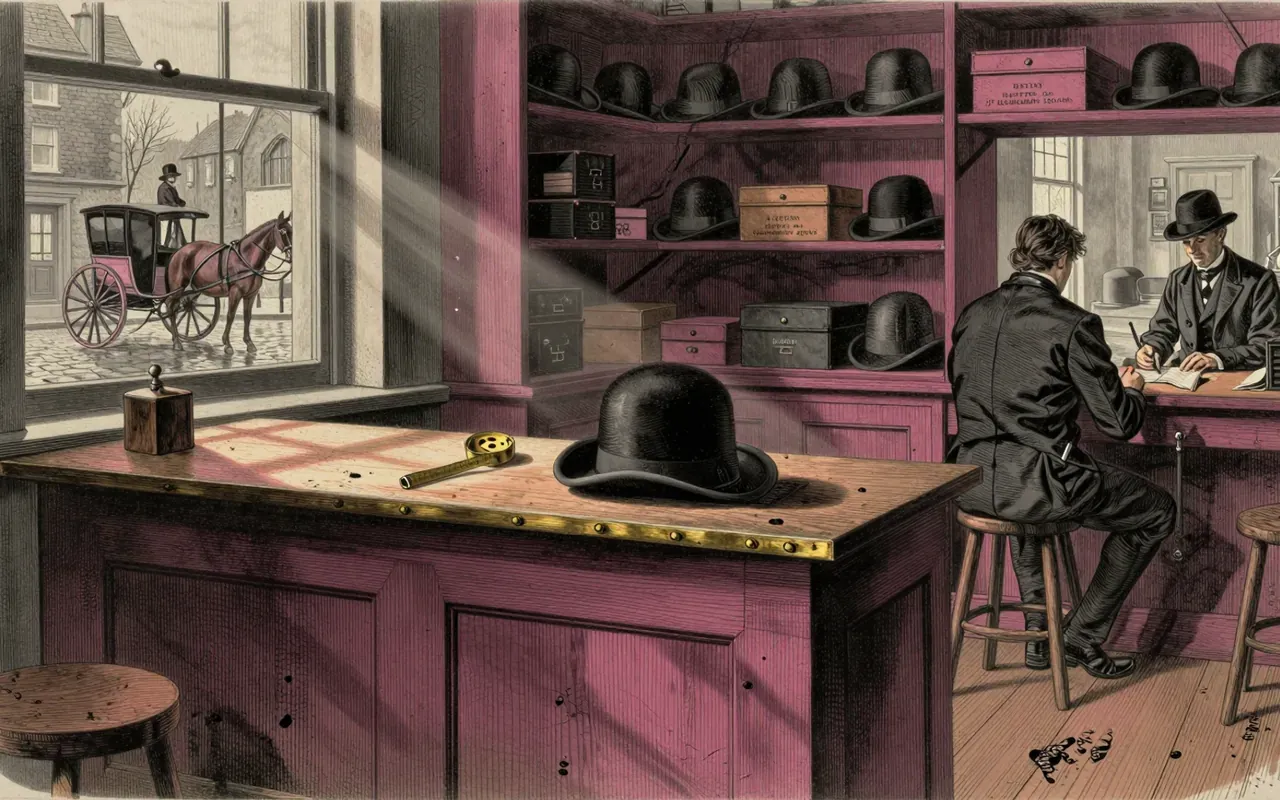
It was made in London in 1849 for one job: shielding gamekeepers’ heads from branches.
2:31
Stomped on, not broken
Its first test was two stomps—and it passed.
3:57
From gamekeeper to banker
It climbed Britain’s class ladder—from working-class staple to City gent uniform by the 1900s.
5:09
Arrived on rails, stayed on heads
In Bolivia, it was never chosen—it arrived with British railway workers and stuck to Quechua and Aymara women.
Worth your time?
Yes. Wear the whole thing.
4/ 5
What works
as evidence of how utility travels
as a marker of occupational need
as a trace of British railway expansion
What does not
iconic
groundbreaking
seminal
Wear it if
historians of material culture
students of colonial infrastructure
designers interested in functional longevity
Skip it if
those seeking aesthetic origin stories
readers looking for individual genius narratives
The written brief1 min read
What the thing is
A hard felt hat with a rounded crown, low crown, and close fit. Not decorative. Not adjustable. Built to resist impact and snagging.
Where it came from
London, 1849. Commissioned by Lock & Co. for Edward Coke, a landowner who needed gamekeepers protected from low-hanging branches while on horseback.
What it gets right
It delivers durable, close-fitting protection for people moving quickly under trees. It withstands being stamped on twice. It fits across bodies and borders without redesign.
What it gets wrong
It assumes uniformity where there was adaptation: worn by Quechua and Aymara women since the 1920s, it was never intended for them—and its adoption there reflects imposition, not fit.
Why it matters now
It shows how utility migrates: from gamekeeper’s headgear to City of London gent (1900s–1970s), then to Bolivian pollera women—carrying colonial infrastructure, not intent.
Is it worth your time
Yes—if you care about how a single functional object outlived its purpose and became a vessel for class, labour, and colonial encounter.