fashionbriefs
8:50in productionCh. 1 · Not wool. Not llama./ 8:50 · ceiling 15 min
Knitwear

Alpaca

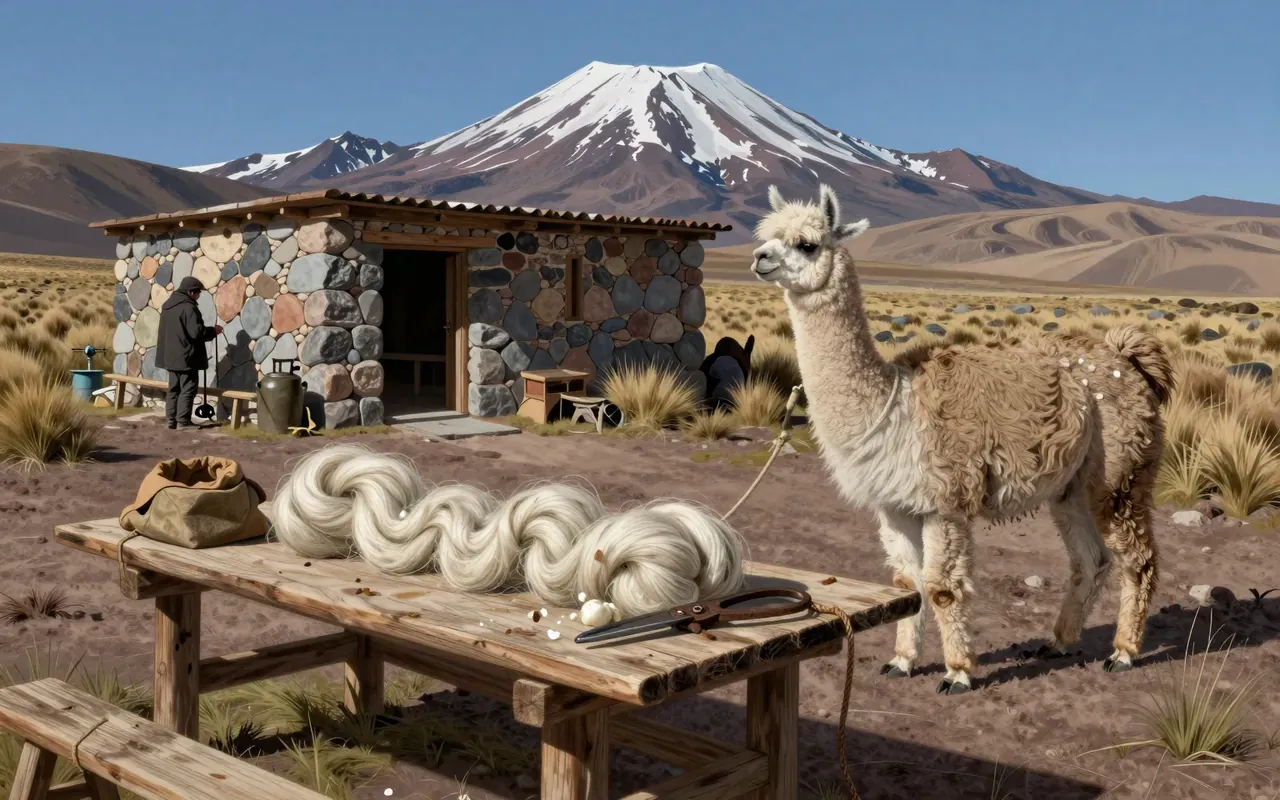
Alpaca isn’t a fabric — it’s a geography, a species, and two fibre types that refuse to behave like wool.

Alpaca is a fibre, not a garment. Its value lies in origin (Peru), species (Vicugna pacos), and structure (Suri locks vs. Huacaya bundles). It offers natural insulation and flame resistance but gives no garment instructions — no cut, no weight, no finish. Its authority is zoological and geographical, not sartorial.

Chapters & takeaways4
  1. 1:03
    Not wool. Not llama.

    Alpaca is a domesticated South American camelid — shorter than the llama and bred solely for fibre.

  2. 2:32
    Two breeds. One name.

    Suri grows in straight locks; Huacaya grows in crimped bundles — a structural difference, not a marketing gloss.

  3. 3:52
    Peru first. Vicuña second.

    In textiles, 'alpaca' means Peruvian alpaca hair — domesticated from vicuñas 5,000–6,000 years ago.

  4. 5:20
    Genetics over guesswork.

    DNA reclassified alpacas from Lama pacos to Vicugna pacos in 2001 — confirming descent from vicuña, not guanaco.

Worth your time?

Yes. Wear the whole thing.

3.5/ 5
What works
  • anchors textile terminology to biology and geography
  • distinguishes Suri and Huacaya by observable structure
  • confirms Peruvian origin as industry standard
What does not
  • specify garment construction
  • name a mill or finish
  • define drape or weight
  • state a season or first use
Wear it if
  • producers verifying Peruvian origin
  • buyers prioritising natural pigment and altitude adaptation
Skip it if
  • those needing machine-washable fibre
  • designers requiring consistent staple length
  • brands relying on synthetic performance benchmarks
The written brief1 min read

What the garment is and where it came from

Alpaca is not a garment. It is a fibre — shorn from domesticated South American camelids raised in the Andes, primarily in Peru, Bolivia, Ecuador, and Chile.

How it works, in terms someone would actually use

Alpaca fibre insulates against cold and damp. It resists water and flame. It sheds annually from the animal.

What it gets right

It gets right the distinction between Suri’s straight locks and Huacaya’s crimped bundles. It anchors ‘alpaca’ in Peruvian fibre, not generic camelid hair.

What it does not

It does not specify weight, drape, stitch count, or garment construction. It names no mill, no weave, no finish, no season.

What it changed

It changed textile sourcing by anchoring a premium fibre category to a single species, two breeds, and one geographic origin — Peru.

Who it is for, and who it is not

It is for makers who source directly from Peruvian herds and buyers who prioritise traceable, naturally pigmented, high-altitude-adapted fibre. It is not for those seeking uniformity, machine-washability, or synthetic performance metrics.

Is it worth your time

It is worth your time only if you need lightweight, naturally coloured, high-altitude-tested insulation — and can verify Peruvian origin and breed type.
Same rail · Knitwear4 of 12
9:07
Benetton Group1965Benetton Group is a fashion house defined by contradiction: a knitwear origin that became an advertising vehicle; a global presence hollowed out by financial failure and ethical withdrawal; a brand that named unity while failing to unify its values with its operations.
8:36
Brunello Cucinelli (brand)1978Brunello Cucinelli is an Italian luxury fashion brand founded in 1978, focused initially on artisanal women's knitwear in coloured cashmere. It operates entirely in Italy, primarily in Umbria, with ethical principles of 'humanistic capitalism' guiding its production, workplace standards, and profit distribution — including donating 20% of profits to charity.
10:44
Cashmere woolCashmere is a goat-fibre textile with documented hygroscopic and thermoregulatory function. Its name derives from Kashmir via 19th-century European trade. China and Mongolia are top producers; Afghanistan ranks third (2019). Both undercoat and guard hair are harvested — the former for apparel, the latter for non-apparel use. Mislabeling and environmental degradation are verified consequences of current production.
9:37
Ganni2000Ganni is a Danish contemporary ready-to-wear fashion brand founded in 2000 as a line of cashmere apparel. It gained recognition as a designer label in the late 2010s under Nicolaj and Ditte Reffstrup. In 2009, the Reffstrups took over the company with Ditte as creative director and Nicolaj as CEO. Harper's Bazaar described Ganni as positioned between fast-fashion retail and haute couture. Ganni is one of the top 20 best-selling brands on Net-a-Porter.
Up next in Fashion

Amiri

· 9:56

Amiri didn’t reinvent luxury—it rerouted its pipeline from Paris to LA and back again.

9:56