fashionbriefs
9:36in productionCh. 1 · Gambara, 1974/ 9:36 · ceiling 15 min
Tailoring · Outerwear

Boglioli

1974

Tailoring without scaffolding: Boglioli’s jacket dyes its way out of tradition.

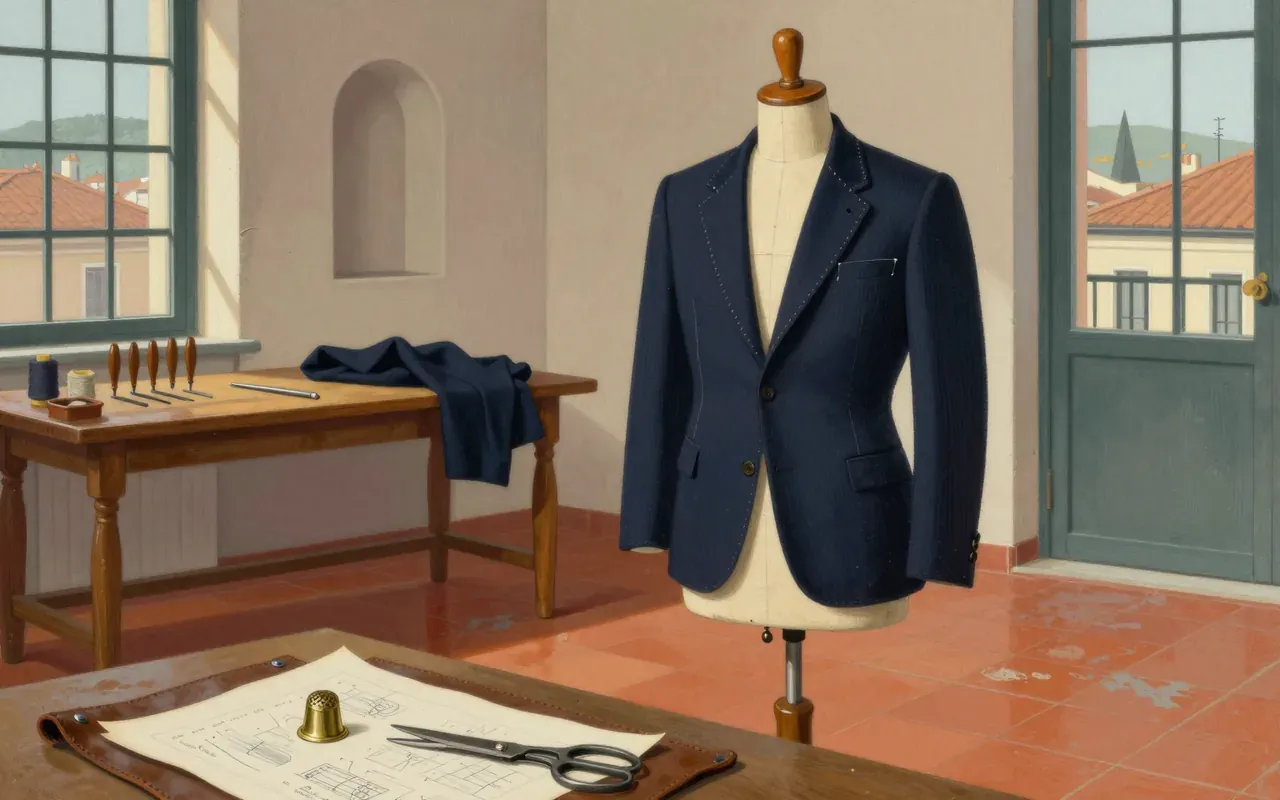
Boglioli redefined Italian tailoring by removing its bones — not as rebellion, but as recalibration. Its garment-dyed cashmere jacket is a functional object first: soft, adaptable, quietly resistant to formality. It expanded internationally because it offered something rare — luxury without hierarchy, structure without stiffness. The 2010s shift to global branding diluted its regional specificity but widened its utility. Womenswear in 2022 confirmed its logic was transferable, not gendered. It remains tailoring — just unmoored from expectation.

Chapters & takeaways5
  1. 0:56
    Gambara, 1974

    Boglioli began as a family-run tailoring house in rural Brescia — not Milan, not Rome, not Florence.

  2. 2:11
    Garment-Dyed Cashmere

    The jacket is deconstructed first, then dyed — dye applied only after stitching, altering texture, weight and tone in one irreversible step.

  3. 3:38
    From Tailoring to Branding

    Private equity ownership in 2013 triggered a deliberate pivot: from regional tailor to global fashion brand, led by Gucci’s former head of tailoring.

  4. 5:00
    Official Style Partner

    The A.C. Milan partnership (2016–2020) anchored Boglioli in sportswear adjacency — not performance, but style-as-identity.

  5. 6:07
    Womenswear, 2022

    Womenswear arrived in 2022 — late, deliberate, and built on the same deconstructed logic as the men’s line.

Worth your time?

Yes. Wear the whole thing.

4/ 5
What works
  • balances luxury and ease
  • uses cashmere for recovery and collapse
  • makes deconstruction serve wear, not just aesthetics
What does not
  • hold formal shape
  • use traditional interlinings
  • prioritise authority or ceremony
Wear it if
  • those who wear tailoring as second skin
  • those who reject rigidity without rejecting craft
Skip it if
  • those who need definition
  • those who require ceremonial presence
The written brief1 min read

What the garment is and where it came from

A deconstructed cashmere jacket. Made in Gambara, Brescia. First introduced in the early 1990s by Pierluigi Boglioli. Not a suit jacket. Not a blazer. A tailored garment stripped of internal architecture.

How it works, in terms someone would actually use

The deconstructed cashmere jacket hangs soft and unstructured. It moves with the body, not against it. Garment-dyeing gives each piece a subtle, uneven depth — no two jackets read the same under light.

What it gets right

It gets the balance of luxury and ease right. Cashmere is used not for opulence alone, but for how it collapses and recovers. The deconstruction serves wear, not just aesthetics.

What it does not

It does not hold shape like a traditional suit jacket. It does not use canvas, horsehair or fused interlinings. It does not aim for formality.

What it changed

It shifted Italian tailoring from rigid construction to post-stitch manipulation. Dyeing after stitching became a signature method — not just for colour, but for texture, weight and drape.

Who it is for, and who it is not

It is for someone who wears tailoring as second skin — not as armour or uniform. It is not for those who need definition, authority or ceremonial presence.

Is it worth your time

Yes, if you want tailoring that refuses rigidity without sacrificing material integrity. No, if you need sharp shoulders or formal structure.
Same rail · Tailoring4 of 35
9:50
Brioni (brand)1945Brioni is a Roman tailoring house founded in 1945. It pioneered the modern menswear runway (1952), invented the trunk show and Prêt Couture, and uses 12,000-stitch construction with extensive pressing. It specialises in sartorial ready-to-wear and made-to-measure. Acquired by Kering in 2011. Operates the Scuola di Alta Sartoria in Penne since 1985.
8:45
Brooks Brothers1818Brooks Brothers is fashion’s first logistics operation. It did not craft silhouettes for beauty or rebellion. It built garments for repetition, durability, and cross-context legibility—starting in 1818, scaling in 1849, and refining through cloth, collar, and cut until 1910. Its legacy is not in how clothes look, but in how they arrive: standardised, sourced, and ready.
10:39
Canali1934Canali is an Italian luxury menswear brand founded in 1934 by brothers Giovanni and Giacomo Canali. It pioneered mechanised cutting in the 1970s, shifted from family management in 2007, adopted athlete-led advertising in 2010, reoriented design toward casual 'homey' wear during the pandemic, and closed its Carate Brianza factory in 2017.
9:48
Corneliani1958Corneliani is an Italian menswear manufacturer founded in Mantua in 1958 by Claudio and Carlalberto Corneliani, tracing its origins to Alfredo Corneliani’s 1930s raincoat and coat business. It expanded internationally with Corneliani USA Inc. in 1985, opened flagship stores in Milan (1997), London (2008), and Shanghai (2013), and launched online retail in the US in 2018. Since 2016, Investcorp has held a 55% stake; the Corneliani family exited operational involvement by 2021. As of 2026, it operates an online store and three UK department store shop-in-shops, and is carried by Harrods, Saks Fifth Avenue, and Bloomingdale's.
Up next in Fashion

Marinière

· 8:18

A naval visibility tool that became fashion’s most obedient rebel.

8:18