fashionbriefs
10:26in productionCh. 1 · Relocation, not revelation/ 10:26 · ceiling 15 min
Tailoring

Savile Row

Savile Row didn’t invent bespoke—it weaponised it, then lost the war over its meaning.

Savile Row is a physical address that became a legal and lexical battleground. It established 'bespoke' as a hand-made standard. It institutionalised that standard in 2004. It lost control of the term in 2008. Its influence is procedural—not stylistic, not cultural, not democratic. It matters because it shows how meaning collapses when craft becomes branding.

Chapters & takeaways4
  1. 1:08
    Relocation, not revelation

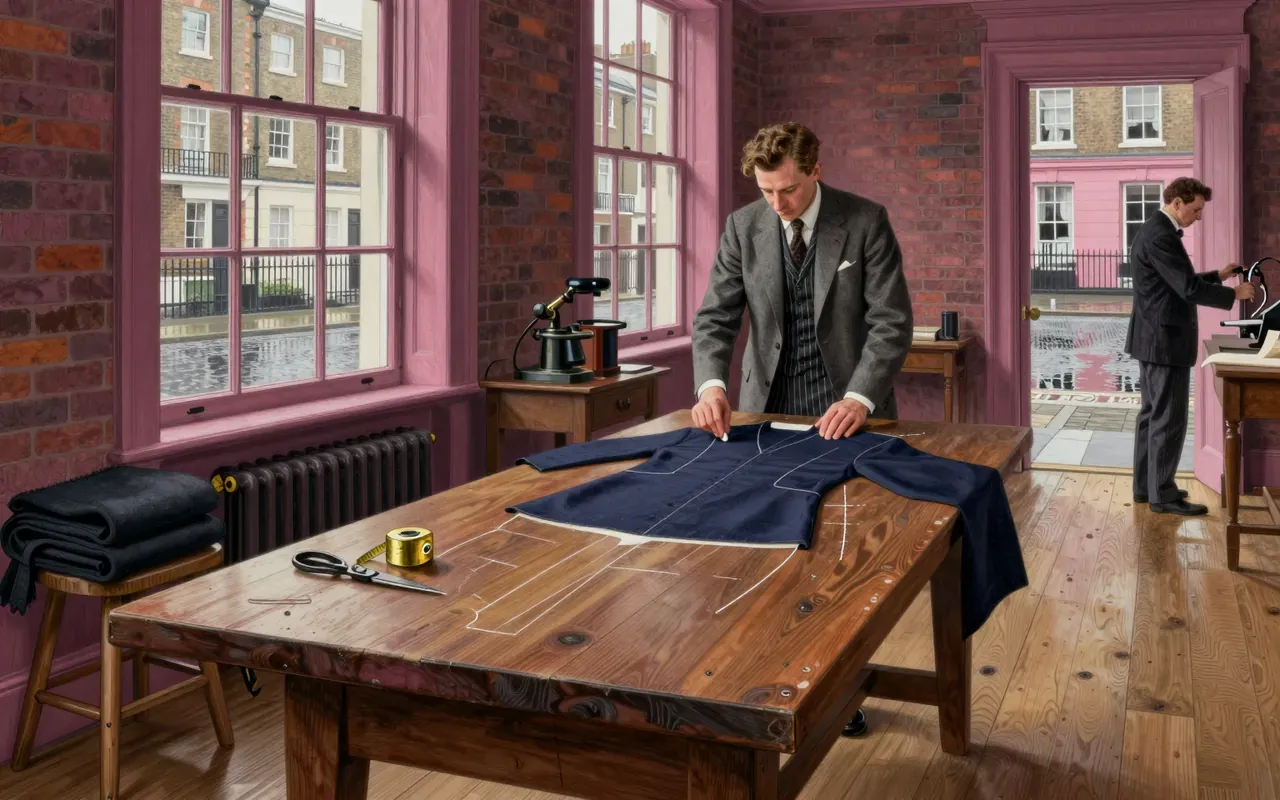
    Savile Row wasn’t born a tailoring hub—it was colonised by tailors who relocated from Cork Street by 1803.

  2. 2:32
    The word was a contract

    ‘Bespoke’ began here as a promise: a suit cut and made by hand—not just measured.

  3. 5:06
    Craft with a stopwatch

    The 2004 Association turned craft into a minimum viable product: 50 hours of hand labour per two-piece suit.

  4. 6:25
    The word was unmade

    In 2008, the ASA erased the hand from ‘bespoke’, letting machines claim the title.

Worth your time?

Yes. Wear the whole thing.

3.5/ 5
What works
  • as a case study in semantic erosion
  • as evidence of craft codification
  • as a warning about regulatory capture
What does not
  • influence designers
  • define menswear
  • represent British identity
  • democratise tailoring
Wear it if
  • linguists
  • regulatory historians
  • garment makers
Skip it if
  • casual shoppers
  • style obsessives
  • cultural theorists
The written brief1 min read

What the thing is

A London street where bespoke tailoring became a regulated craft practice—and a contested label.

Where it came from

Tailors moved from Cork Street to Savile Row by 1803. The street emerged among merchant tailors between 1731 and 1735; its tailoring period began in the late 18th century.

What it gets right

It codifies hand labour. The Savile Row Bespoke Association’s 50-hour rule anchors ‘bespoke’ to measurable craft, not aspiration.

What it gets wrong

It surrendered the word ‘bespoke’ in 2008. The ASA ruling let machine-sewn, made-to-measure garments claim the term—erasing the hand-cut, hand-made definition it originated to describe.

Why it matters now

Because ‘bespoke’ is now everywhere—from coffee to code—and Savile Row is the only place where its original meaning was formally defined, then officially diluted.

Is it worth your time

Yes—if you care about precision in language, the material reality of craft, or how institutions police meaning. No—if you want a story of rebellion, disruption, or democratic fashion.
Same rail · Tailoring4 of 19
9:11
Gieves & Hawkes1771Gieves & Hawkes is a London-based bespoke men's tailor founded in 1771, originally serving the British Army and Royal Navy—and by extension the royal family—through military and ceremonial tailoring. It established itself on Savile Row after acquiring No. 1 in 1912, partly due to its longstanding association with explorers. In 1974, Gieves Ltd merged with Hawkes & Co., adopting the current name and securing the freehold. It pioneered ready-to-wear suits on Savile Row in the 1920s and appointed the first female head cutter there in 2009. Ownership passed through several entities—including Trinity Ltd. and Frasers Group—following financial restructuring.
7:50
Hedi SlimaneHedi Slimane’s 'skinny' silhouette is a garment system built on subtraction: less fabric, less ease, less margin. It emerged in Dior Homme’s Black Tie collection for autumn-winter 2000–01. It functions by compressing the body’s horizontal planes and amplifying vertical continuity. It gets right the authority of austerity—but fails where bodies deviate from its narrow ideal. It changed menswear’s grammar from volume to vector. It is for those who see clothing as calibration, not camouflage. It is worth your time only if you accept that elegance begins where comfort ends.
9:16
Zegna1910Zegna is a vertical wool system — not a fashion house in the conventional sense. Its garments are calibrated for endurance, not expression.
8:33
Azzedine AlaïaAzzedine Alaïa’s garment is a Paris-based ready-to-wear line launched in 1980. It uses leather and inventive knits. Its defining features are tight fit, curve-accenting seaming, and, from the early 1990s, corselets and bust wiring. Construction draws from study of Vionnet and Balenciaga garments. It relies on cut and body revelation over colour.
Up next in Fashion

Sneakers

· 9:22

Sneakers were never about style—they were about silence, grip, and getting away with it.

9:22