fashionbriefs
8:46in productionCh. 1 · Sun Protection/ 8:46 · ceiling 15 min
Accessories

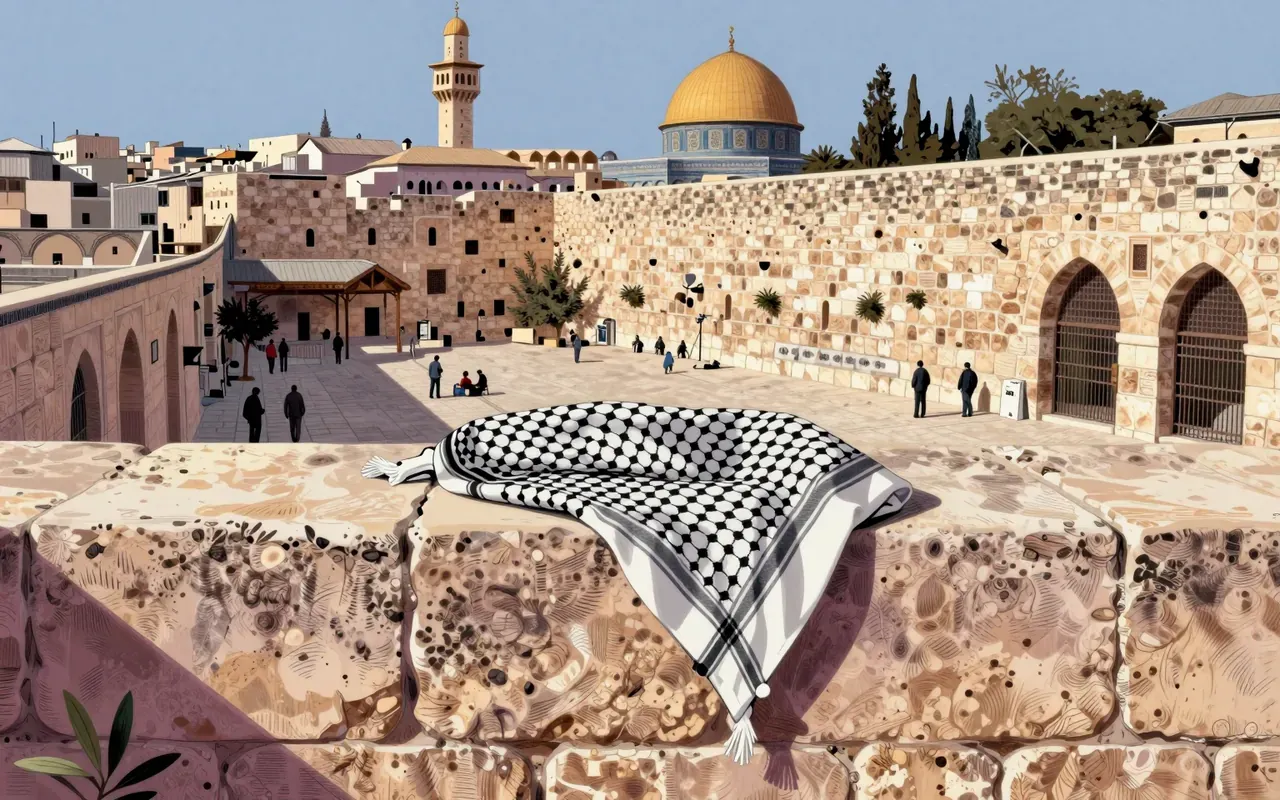
Keffiyeh

A sun shield turned political weapon by decree—not culture.

The keffiyeh is a functional textile that became a national symbol through two top-down political interventions: first, an Arab rebel order during the 1936–1939 revolt; second, a British military directive in the 1950s. Its meaning is not emergent—it is assigned, enforced, and contested.

Chapters & takeaways4
  1. 0:58
    Sun Protection

    It began as desert utility—not identity.

  2. 1:50
    Revolt Uniform

    In 1938, eight out of ten tarbushes vanished overnight—replaced by keffiyeh on command.

  3. 3:23
    British-Made Symbol

    The black-and-white pattern was invented in the 1950s by a British officer to tell Palestinian soldiers from Jordanians.

  4. 4:59
    National Identity Tool

    It functions as a politicised symbol—not a folk tradition.

Worth your time?

Yes. Wear the whole thing.

4.5/ 5
What works
  • as-a-case-study-in-symbolic-coercion
  • as-evidence-of-mandatory-cultural-shift
What does not
  • art
  • fashion
  • design
Wear it if
  • students-of-political-symbolism
  • readers-tracking-colonial-administration
Skip it if
  • fashion-historians-seeking-aesthetic-lineage
  • textile-artisans-studying-weave-techniques
The written brief1 min read

What the thing is

A square cotton or wool headscarf, folded and draped over the head or shoulders.

Where it came from

Bedouin sun protection—designed for arid regions to block sunburn, dust, and sand.

What it gets right

It signals collective identity under occupation. The 1936–1939 revolt order turned it into a mass uniform. The 1950s black-and-white variant cemented its distinction as Palestinian—not Arab, not Jordanian.

What it gets wrong

It implies universality. It was never worn by all Arabs before the 1930s. Villagers wore white; city elites wore tarbushes. Its symbolism was imposed, not inherited.

Why it matters now

Because its meaning is legally policed: banned in some countries, criminalised on campus, weaponised in discourse—yet its origins are purely practical, not ideological.

Is it worth your time

Yes—if you need to understand how a functional object becomes a contested national symbol through deliberate political acts, not organic cultural drift.


Same rail · Accessories4 of 25
9:29
Love bracelet (Cartier)The Love bracelet is not jewellery you put on. It is jewellery you submit to. It locks. It commits. It demands a second party — not just as wearer, but as keeper of the key.
11:29
Colette (boutique)1997Colette was a Parisian concept boutique founded in 1997. It closed in December 2017. It sold high fashion, streetwear, and accessories. It hosted exhibitions, ran a bookshop, and operated a water bar with over 100 bottled water brands. It launched early collections by Jeremy Scott, Raf Simons, Proenza Schouler, Rodarte, Mary Katrantzou, Sacai, Simone Rocha, Christopher Kane, and Olympia Le Tan. In 2016, it generated €32 million in sales, 25% online. Forbes named it 'the trendiest store in the world' in December 2005. Esquire compared it to Kith, Bergdorf Goodman, and Opening Ceremony.
9:16
Fashion blogFashion blog is a digital publishing format covering the fashion industry, clothing, and lifestyle topics. It functions as a disruptive, democratizing force in fashion media, delivering real-time feedback, influencing design and marketing, and reshaping industry power dynamics by enabling broad public participation and challenging traditional gatekeepers like editors and magazines.
11:01
Baguette (bag)The Baguette is a small, compact handbag designed by Silvia Venturini Fendi for Fendi in 1997. It was conceived as a streamlined, short-strap bag adaptable across looks, colors, and textures while retaining a consistent aesthetic — contrasting with large totes then popular. Fendi lent Baguettes as props to Sex and the City, becoming the first luxury house to lend a piece to costume designer Patricia Field; Carrie Bradshaw’s on-screen identification of it as a 'Baguette' during a mugging scene and Sarah Jessica Parker’s attribution of the show’s and character’s establishment to it underscore its cultural impact, which culminated in LVMH’s 1999 acquisition of Fendi. In 2012, Fendi celebrated the bag’s 15th anniversary with an exhibition at Colette in Paris.
Up next in Fashion

Kilt

1720 · 10:36

The kilt wasn’t born in Gaelic tradition—it was invented by an English Quaker to speed up Highland timber workers.

10:36