fashionbriefs
10:36in productionCh. 1 · Not a skirt. A severed skirt./ 10:36 · ceiling 15 min
Garments

Kilt

1720

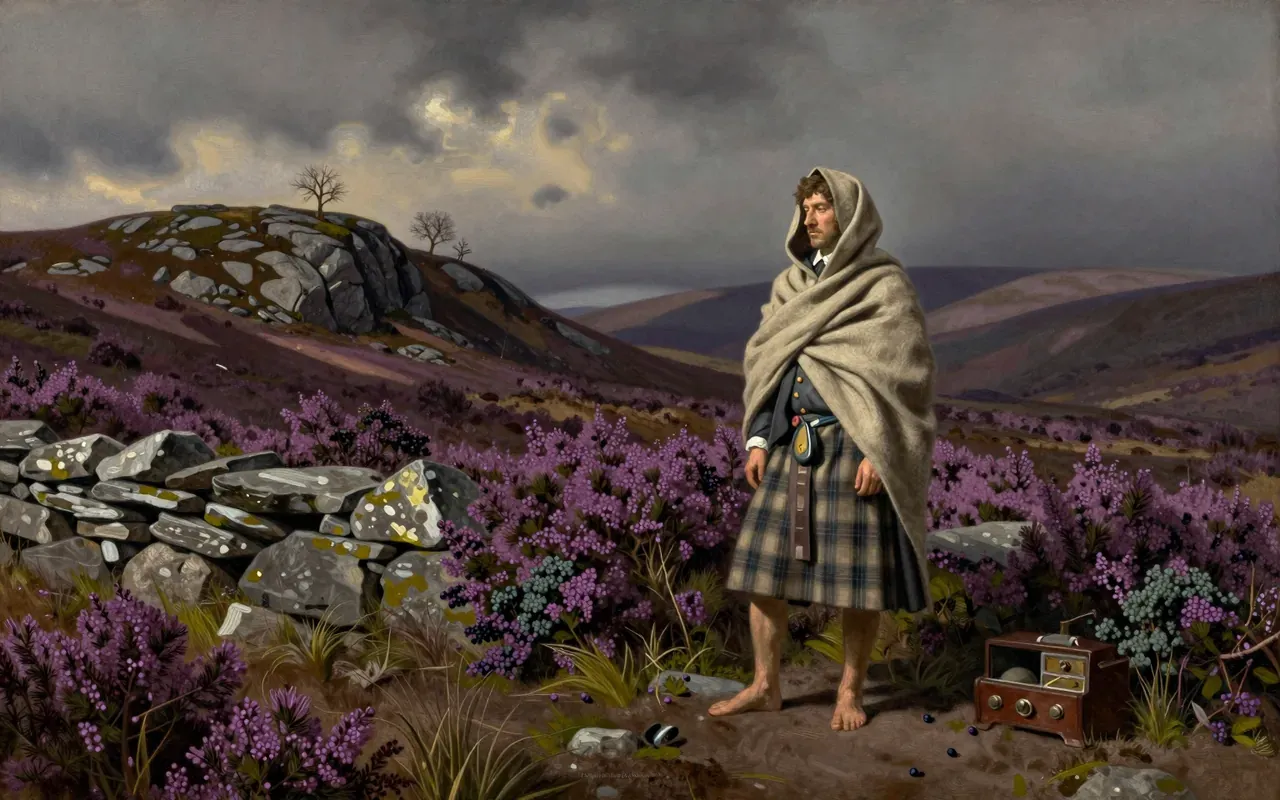
The kilt wasn’t born in Gaelic tradition—it was invented by an English Quaker to speed up Highland timber workers.

The kilt is a functional garment that was rebranded as cultural heritage long after its invention.

Chapters & takeaways6
  1. 0:54
    Not a skirt. A severed skirt.

    The modern kilt is a knee-length, pleated wool skirt—distinct from its full-length ancestor.

  2. 1:59
    The original was two garments in one.

    The great kilt was a versatile, full-length Highland garment—half cloak, half robe.

  3. 3:28
    An English Quaker cut it down.

    Thomas Rawlinson invented the small kilt in the 1720s by cutting and sewing the belted plaid’s lower half.

  4. 4:43
    Pleats were optional until they weren’t.

    Unsewn philibegs existed from the 1690s—but Rawlinson’s version fixed the pleats permanently.

  5. 5:49
    Function first. Identity later.

    Worsted wool, tartan, and pre-sewn pleats made it durable, identifiable, and efficient.

  6. 7:10
    National dress is a 19th-century retrofit.

    It became a symbol of Scottish and Gaelic identity only from the 19th century onward—not in 1720.

Worth your time?

Yes. Wear the whole thing.

4/ 5
What works
  • as a case study in how utility becomes emblem
What does not
  • colonialism
  • masculinity
  • nationalism
Wear it if
  • historians of material culture
  • designers studying functional adaptation
  • students of symbolic retrofitting
Skip it if
  • those seeking origin myths
  • romantics of Highland tradition
  • fans of unverified lineage claims
The written brief1 min read

What the thing is

A knee-length, pleated, wrap-around wool skirt with tartan patterning.

Where it came from

It emerged from the Scottish Highlands, where the great kilt (recorded from the 16th century) was worn as full-length garment with cloak functionality.

What it gets right

It solved a real problem: the great kilt was cumbersome for industrial work. Rawlinson’s sewn-pleat small kilt was lighter, faster to put on, and easier to move in.

What it gets wrong

It falsely presents itself as a continuous Highland tradition. The 1720s version was an English Quaker’s factory-floor adaptation—not Gaelic design.

Why it matters now

It shows how functional garments get retrofitted with nationalist meaning—decades after their invention, not during.

Is it worth your time

Yes—if you care how practical innovations become political symbols.
Same rail · Garments4 of 66
10:13
CasablancaCasablanca is a city. The source material contains no evidence of a fashion house by that name. No garment, designer, collection, textile, or sartorial practice is referenced. All claims pertain to geography, finance, industry, and infrastructure.
9:05
CottonCotton is a naturally occurring, soft, fluffy staple fiber derived from the bolls of Gossypium plants—shrubs native to tropical and subtropical regions across the Americas, Africa (including Egypt), and India. It is nearly pure cellulose, with minor waxes, fats, pectins, and water, and its bolls aid seed dispersal. Domesticated independently in both Old and New Worlds, cotton has been used for textiles since prehistoric times, with archaeological evidence from Peru (7th–6th millennia BC) and Pakistan (6th millennium BC). It is most commonly spun into yarn or thread to produce soft, breathable, durable fabrics.
9:48
DistressingDistressing is a surface-altering technique used on furniture and instruments to mimic age. It relies on controlled destruction of finishes — sanding, stripping, chiselling — to reveal substrate and layer history. It works best on solid pine. It does not occur on garments. It signals curated history, not lived time.
10:34
Dover Street MarketDover Street Market is a retail institution founded in 2004 by Rei Kawakubo and Adrian Joffe on Dover Street in Mayfair, London. It was conceived as a curated, art-integrated space inspired by Kensington Market, defined by Kawakubo’s phrase 'beautiful chaos'. It stocks Comme des Garçons and other selected brands, collaborates with Frieze Art Fair, Michael Hoppen Gallery and ICA, and relocated in 2016 to the former Burberry building on Haymarket.
Up next in Fashion

Lederhosen

· 9:24

Lederhosen aren’t Bavarian tradition—they’re alpine workwear that got colonised by national myth.

9:24