fashionbriefs
8:10in productionCh. 1 · Acquired, not discovered/ 8:10 · ceiling 15 min
Tailoring

The Waistcoat

1882

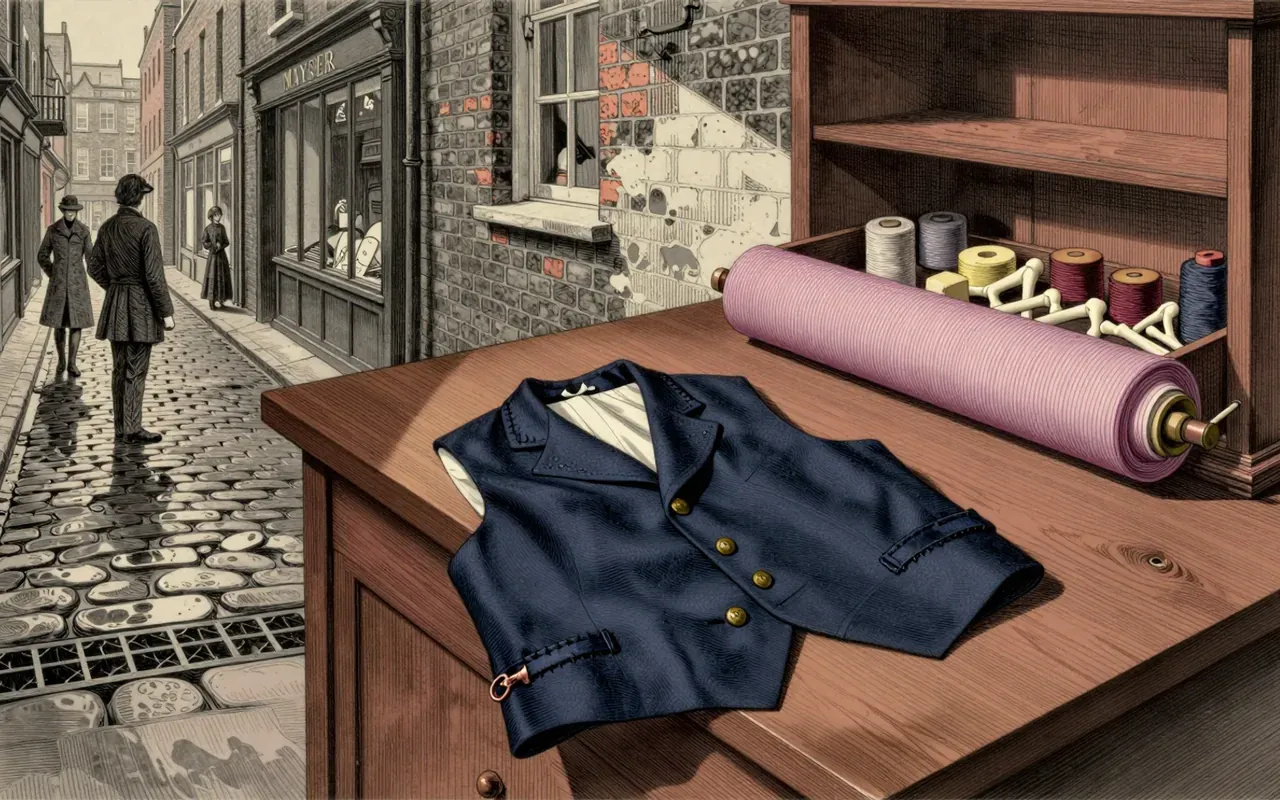
A waistcoat with two shortened bands proves love is often a lie told in stitches.

A literary depiction of impoverished Warsaw life in 1882, centred on a waistcoat whose physical alterations reveal a reciprocal act of compassion between a dying husband and his wife — reconstructed by the narrator through observation and acquisition.

Chapters & takeaways5
  1. 1:02
    Acquired, not discovered

    The narrator bought the waistcoat for half a ruble from a Jewish peddler — not as artefact, but as relic.

  2. 1:58
    Wear as record

    Its stains, threadbare back and missing buttons are evidence — not atmosphere.

  3. 2:52
    Two bands, two deceptions

    He shortened one band to hide wasting; she shortened the other to feed hope.

  4. 3:47
    Deception as care

    Their mutual lies were benevolent — not failures of truth, but acts of maintenance.

  5. 5:14
    Reconstruction, not recollection

    The narrator reconstructs the story from observation — not testimony, not memory, but inference.

Worth your time?

Yes. Wear the whole thing.

4/ 5
What works
  • as a counterpoint to realism that prioritises motive over mechanism
  • as a model of how objects can hold unspoken agreements
What does not
  • culture/fashion
Wear it if
  • readers who distrust emotional exposition
  • students of narrative economy
  • anyone tired of trauma-as-revelation
Skip it if
  • those who need resolution
  • readers seeking historical context beyond what is stated
  • anyone expecting social critique beyond the domestic
The written brief1 min read

What the thing is

A short literary work from 1882 about a worn waistcoat whose physical alterations encode a dying man’s effort to hide his decline and his wife’s effort to sustain his hope.

Where it came from

Warsaw, 1882. It emerged from impoverished Jewish life there, acquired by the narrator from a Jewish peddler for half a ruble.

What it gets right

It shows mutual concealment as tenderness. The waistcoat’s two altered bands prove that compassion can operate through silence and subtraction.

What it gets wrong

It assumes the reader will accept the narrator’s reconstruction as authoritative. There is no evidence he witnessed any of it — only that he observed, acquired, and interpreted.

Why it matters now

Because it treats self-deception not as failure but as shared infrastructure — a quiet, material alternative to honesty in crisis.

Is it worth your time

Yes — if you want a precise, unsentimental study of self-deception as care.
Same rail · Tailoring4 of 33
9:36
Boglioli1974Boglioli redefined Italian tailoring by removing its bones — not as rebellion, but as recalibration. Its garment-dyed cashmere jacket is a functional object first: soft, adaptable, quietly resistant to formality. It expanded internationally because it offered something rare — luxury without hierarchy, structure without stiffness. The 2010s shift to global branding diluted its regional specificity but widened its utility. Womenswear in 2022 confirmed its logic was transferable, not gendered. It remains tailoring — just unmoored from expectation.
9:50
Brioni (brand)1945Brioni is a Roman tailoring house founded in 1945. It pioneered the modern menswear runway (1952), invented the trunk show and Prêt Couture, and uses 12,000-stitch construction with extensive pressing. It specialises in sartorial ready-to-wear and made-to-measure. Acquired by Kering in 2011. Operates the Scuola di Alta Sartoria in Penne since 1985.
8:45
Brooks Brothers1818Brooks Brothers is fashion’s first logistics operation. It did not craft silhouettes for beauty or rebellion. It built garments for repetition, durability, and cross-context legibility—starting in 1818, scaling in 1849, and refining through cloth, collar, and cut until 1910. Its legacy is not in how clothes look, but in how they arrive: standardised, sourced, and ready.
10:39
Canali1934Canali is an Italian luxury menswear brand founded in 1934 by brothers Giovanni and Giacomo Canali. It pioneered mechanised cutting in the 1970s, shifted from family management in 2007, adopted athlete-led advertising in 2010, reoriented design toward casual 'homey' wear during the pandemic, and closed its Carate Brianza factory in 2017.
Up next in Fashion

Adidas Superstar

· 8:15

A basketball shoe that won the NBA by 1973—and then vanished from the court, only to reappear on every street that mattered.

8:15