fashionbriefs
10:28in productionCh. 1 · Commissioned, not conceived/ 10:28 · ceiling 15 min
Outerwear

Trench coat

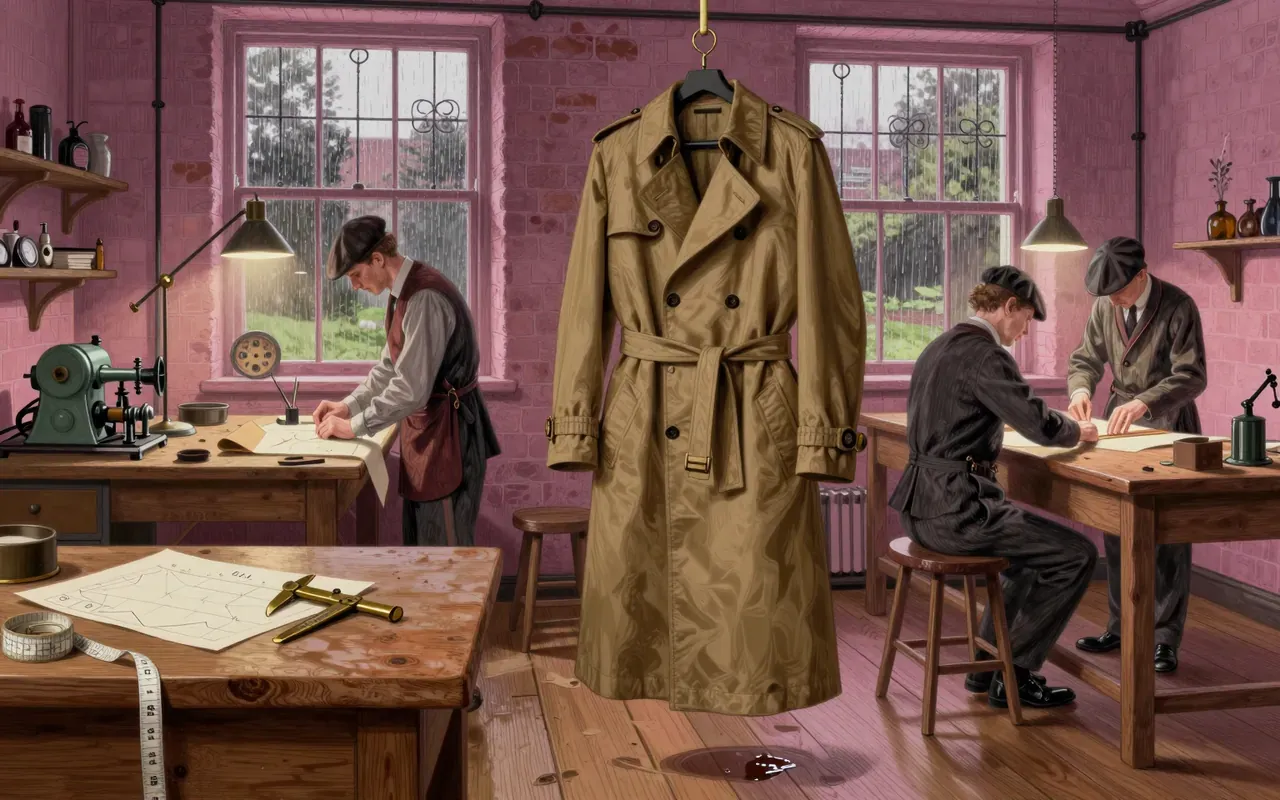
A raincoat designed for officers in the mud became the uniform of people who’ve never seen a trench.

The trench coat is a functional garment that solved a narrow military problem. Its civilian life is a story of displacement—not evolution.

Chapters & takeaways5
  1. 0:56
    Commissioned, not conceived

    It was commissioned by the British War Office—not invented out of inspiration—and built for a specific rank, before the First World War.

  2. 2:18
    Function first, every stitch

    Every detail—from the storm flap to the buckled cuffs—was engineered for use in trenches, not style.

  3. 3:23
    Not built for cold

    It fails as winter wear. Its sizing and fabric assume it will be layered over the British Warm.

  4. 4:36
    Adopted, not inherited

    Civilian adoption came after military use—not alongside it, and not by choice of the original users.

  5. 6:04
    One problem, one solution

    The gabardine trench coat was a complete system: fabric, cut, and hardware designed as one response to a single brief.

Worth your time?

Yes. Wear the whole thing.

4.5/ 5
What works
  • as an object lesson in functional design
  • as evidence of how quickly utility becomes aura
What does not
  • art
  • subculture
  • movement
  • ideology
Wear it if
  • designers
  • historians of material culture
  • people who own one and wonder why it doesn’t keep them warm
Skip it if
  • anyone expecting symbolism or rebellion
The written brief1 min read

What the thing is

A double-breasted, belted raincoat made from lanolin-waterproofed gabardine. Khaki-coloured. Built for British Army officers. Features storm flaps, button-closing pockets and epaulettes, raglan sleeves with buckling cuff straps, and D-ring belt clasps.

Where it came from

Thomas Burberry designed it in 1900 after a commission from the British War Office to replace heavy military coats. It emerged before the First World War and was worn by officers in the trenches.

What it gets right

It solves a precise problem: keeping officers dry in wet trenches while allowing mobility, layering over the British Warm, and carrying gear. Every feature—storm flap, buckled cuffs, epaulettes, D-rings—has a documented battlefield purpose.

What it gets wrong

It is routinely misused as cold-weather outerwear. It was never designed for thermal insulation. Its generous sizing and breathable gabardine make it inadequate as sole winter protection.

Why it matters now

It remains the default visual shorthand for competence, restraint, and quiet authority—despite being stripped of its original function, context, and user group.

Is it worth your time

Yes—if you care about how functional design becomes cultural shorthand, and want to see what happens when military pragmatism gets repackaged as civilian authority.
Same rail · Outerwear4 of 33
8:57
A-2 jacketThe A-2 jacket is a functional military garment defined by its adoption date, material, and deliberate departures from the A-1. Its authority comes from specification, not sentiment. It endures because it was built to be issued—not admired.
9:36
Boglioli1974Boglioli redefined Italian tailoring by removing its bones — not as rebellion, but as recalibration. Its garment-dyed cashmere jacket is a functional object first: soft, adaptable, quietly resistant to formality. It expanded internationally because it offered something rare — luxury without hierarchy, structure without stiffness. The 2010s shift to global branding diluted its regional specificity but widened its utility. Womenswear in 2022 confirmed its logic was transferable, not gendered. It remains tailoring — just unmoored from expectation.
9:10
Donegal tweedDonegal tweed is a plain-weave wool fabric from County Donegal, Ireland. It was historically handwoven for caps, suits and vests using local materials. Its modern form dates to the 1880s. Machine weaving arrived in the 1950s–60s. It is best known for a plain-weave cloth with differently-coloured warp and weft and small, irregularly placed coloured yarns yielding a heathered effect. Magee, founded in 1866, became the largest and most famous producer. Such fabric is often labelled 'donegal' regardless of where it is made.
9:24
Polar fleecePolar fleece is a soft, napped, insulating polyester fabric developed by Malden Mills in Massachusetts in 1979. It was co-developed with Patagonia as Synchilla to mimic and surpass wool. Malden Mills CEO Aaron Feuerstein declined to patent it, enabling broad adoption. It is trademarked as PolarFleece since October 6, 1981. Its warmth depends on loft and trapped air pockets. Weight variants are defined in grams per square meter (gsm): micro, 100, 200, and 300. It is hydrophobic but loses insulation when wet. It generates static and sheds microfibres during washing and drying.
Up next in Fashion

Tommy Hilfiger

Tommy Hilfiger · 8:28

Preppy wasn’t born on Ivy League quads—it was rebuilt in Times Square after a bankruptcy.

8:28